

Obituary: In warm memory of Professor Denise Salin (1975 - 2026)
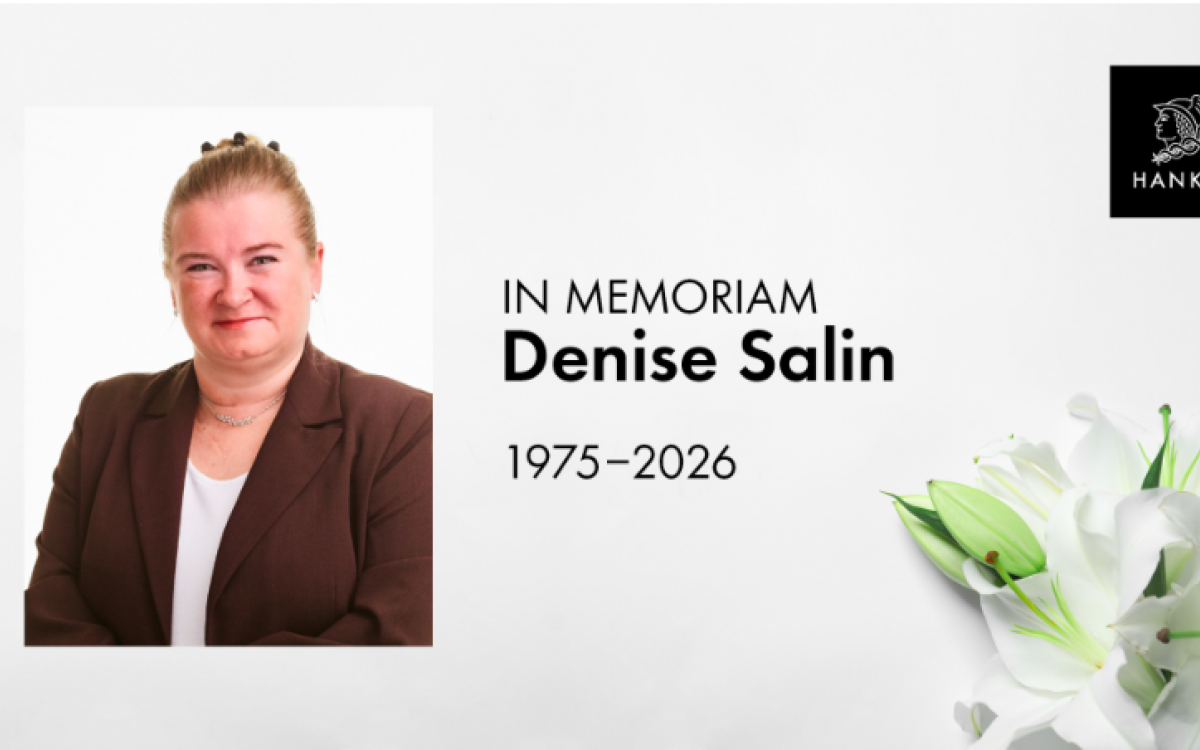
The research field into workplace bullying, harassment, and incivility at work has lost one of its most prolific and cited colleagues, Professor Denise Salin. Denise Salin sadly passed away suddenly in the summer of 2026 after a tragic accident while on holiday in Africa. We, the research community, received the tragic news of the passing of our esteemed and wonderful colleague with profound shock and sadness.
She earned her doctorate from Hanken School of Economics in Helsinki, Finland, in 2003, where she was appointed associate professor in 2010 and full professor of management and organization in 2015.
Her involvement in the international research community began early in her career. Denise was among the pioneers of workplace bullying research, with her first publications as early as in 2001 at the age of only 26. Denise attended her first international conference at the Congress of the European Association on Work and Organizational Psychology (EAWOP) in Helsinki in1999 and presented her own research at the EAWOP congress in Prague in 2001. That same year, she published her first international peer-reviewed article on workplace bullying, examining its prevalence among business professionals and comparing different measurement methods. In 2003, while completing her doctoral studies, Denise wrote what would become one of the most influential and cited contributions to the field: “Ways of explaining workplace bullying: A review of enabling, motivating and precipitating structures and processes in the work environment”, published in Human Relations. In this article, she developed an organizational perspective on workplace bullying that would influence research in the field for decades to come. More than twenty years later, the article continues to be widely cited, illustrating the lasting relevance of the ideas she developed at an early stage of her career. In 2003 she published two more peer-reviewed articles on workplace bullying, an achievement that led the seniors in the field to quickly understand that we here saw a particularly gifted young scholar who would be able to contribute enormously to the field in the years to come. Over the course of her career, Denise developed an extensive body of scholarship, comprising more than 35 journal articles, twelve book chapters, and a co-edited volume.
No wonder Denise became one of the most respected and internationally cited scholars in the field. Her academic work has attracted considerable international attention and has had a significant impact both within the research community and in working life in general. Her research focused particularly on the organizational causes and antecedents of workplace bullying, while also addressing gender, perceptions, and interpretations of bullying. In later years she contributed especially to our understanding of the role of HRM practices, leadership, and organizational structures in the prevention and management of workplace bullying.
Across her extensive body of work, five broad and partly overlapping themes stand out:
1. Organizational antecedents and enabling conditions – Denise was instrumental in advancing an understanding of workplace bullying as an organizational phenomenon, shaped by structures and processes that may enable, motivate, or precipitate bullying.
2. HRM, organizational responsibility, prevention and intervention – Her work increasingly shifted attention from why bullying occurs to what organizations can do to prevent and manage it, including the role of HR practices and ethical organizational infrastructures.
3. Workplace bullying as a gendered phenomenon – Denise demonstrated how gender matters not only for prevalence, but also for forms of bullying, risk factors, perceptions, responses, and consequences.
4. Perception, interpretation, and contextual understandings of bullying – Her research showed that negative behaviors are interpreted within a social context, with factors such as gender, status, organizational norms, and culture influencing whether and how behaviors are recognized as bullying.
5. Bystanders and the wider social context of workplace bullying – Denise also contributed to our understanding of how third parties interpret and respond to bullying, how bystanders may influence the process, and how witnessing bullying can itself have consequences.
While much of Denise’s early work was published as a sole author, she later developed fruitful collaborations with many scholars around the world. Through these collaborations, conference encounters, and scientific exchanges, she became a highly valued member of the international research community and an inspiration to so many young and emerging researchers. Those of us who had the privilege of knowing and working with Denise will always remember her for her warmth, kindness, and integrity. A particular characteristic quality was her ability to present strong arguments for her theoretical perspectives and empirical findings and to stand her ground in scientific discussions, while always doing so in a friendly, respectful and generous way. She combined intellectual strength with kindness in a way that made discussions with her both stimulating and enjoyable.
Although sorely missed, Professor Denise Salin will live on through her valuable research and the lasting impression she made on so many of us.
On behalf of the research community,
Professor Ståle Valvatne Einarsen, University of Bergen, Norway
Professor Dieter Zapf, Johann Wolfgang Goethe-University Frankfurt am Main, Germany
Professor Guy Notelaers, University of Bergen, Norway
Professor Elfi Baillien, KU Leuven, Belgium
Professor Michael Rosander, Linköping University, Sweden
